
Most businesses don't actually need to choose between "a website" and "a web application" forever. What you need is clarity on what you're building first, why you're building it, and what success looks like six months after launch.
A website is usually your public-facing presence, built to inform, persuade, and convert visitors. A web application is built to help users do something, often repeatedly, usually with accounts, data, and workflows.
Below is a practical decision guide (with real trade-offs) to help you choose the right path.
Website vs web application: simple definitions (with examples)
What most people mean by "website"
A website is primarily content and conversion. It may include pages like Home, About, Services, Blog, Pricing, and Contact.
Common examples:
- Marketing sites and landing pages
- Company brochure sites
- Content hubs (blogs, resource libraries)
- Simple lead-gen sites (forms, click-to-call, bookings)
What most people mean by "web application"
A web application is primarily functionality and interaction. It typically involves user accounts, permissions, data creation or editing, integrations, and ongoing feature evolution.
Common examples:
- Customer portals (invoices, order history, documents)
- Dashboards and analytics tools
- Booking systems with user profiles
- Marketplace platforms
- Internal tools (inventory, operations, approvals)
If you're unsure whether your idea "counts," a good rule is this: if users need to log in and return frequently to complete tasks, you are likely building a web application.

The fastest decision framework: start with the job your product must do
Instead of starting with technology, start with the primary business job.
Build a website when the main job is marketing and trust
A website is the right first build when success is:
- Getting discovered (search, ads, referrals)
- Explaining your offer clearly
- Building credibility (case studies, proof, FAQs, positioning)
- Capturing leads (forms, calls, demos)
This is common for service businesses, local businesses, consultants, and new startups validating demand.
Build a web application when the main job is self-service and operations
A web application is the right first build when success is:
- Users completing tasks without your team's involvement
- Reducing manual work (admin time, spreadsheets, email chains)
- Delivering repeatable value (tools, portals, subscriptions)
- Handling transactions, workflows, or complex data
This is common for SaaS, marketplaces, membership products, and businesses with process-heavy operations.
Consider a hybrid when you need both outcomes
Many mature digital products have:
- A public marketing website (fast, content-rich, SEO-focused)
- An authenticated web app (features, data, workflows)
Often the best sequencing is website first (to clarify positioning and drive demand), then web app (to scale delivery).
Key differences that matter in planning
Here's what changes materially when you choose a web application instead of a website.
| Area | Website (typical) | Web application (typical) |
|---|---|---|
| Primary goal | Inform and convert | Enable tasks and outcomes |
| Audience | Mostly first-time visitors | Mostly returning users |
| UX complexity | Navigation, reading, CTAs | Flows, states, errors, edge cases |
| Data | Mostly published content | User-generated and system data |
| Authentication | Optional | Common (login, roles, permissions) |
| SEO importance | Usually high | Mixed (public pages matter most) |
| Integrations | Often light (forms, CRM) | Often heavy (payments, APIs, automation) |
| Testing needs | Basic functional testing | Deeper QA (flows, security, regression) |
| Maintenance | Content updates, minor changes | Ongoing features, monitoring, fixes |
| Security surface | Smaller | Larger (accounts, data, permissions) |
When you should build a website (and not a web app)
A website is often the highest ROI choice when:
You're still validating demand
If you cannot confidently answer "who is this for" and "why will they choose us," building app features is risky. A well-structured website plus analytics can validate:
- Which messaging converts
- Which channels bring qualified traffic
- What objections keep prospects from contacting you
Your core workflow is still human-driven
If your delivery is mostly calls, proposals, and manual fulfillment, a web app can become expensive "process cement." It locks in today's workflow before you've optimized it.
Your biggest constraint is trust, not functionality
Many businesses don't lose leads because they lack features. They lose leads because prospects cannot quickly find:
- Clear offer and outcomes
- Proof (portfolio, case studies, testimonials)
- Pricing context or next steps
In these cases, invest in a website that sells.
When you should build a web application (and not just a website)
A web application tends to be the right investment when:
You need user accounts, permissions, or private content
The moment you have different user types (customers, admins, vendors, staff), you are in web app territory. Permissions and role-based access become first-class requirements.
Your product is a workflow
If the value is created through a sequence of steps (submit, approve, track, export, notify), you need an application mindset: states, edge cases, audit trails, and reliability.
You need system integrations to deliver the service
Examples include payments, shipping, scheduling, identity providers, CRM, ERP, accounting, or custom APIs. Integrations increase complexity, but they can also unlock scale.
Your team is drowning in operational overhead
If staff are copying data between tools, reconciling spreadsheets, or chasing updates through email, an internal web application can pay off quickly.
The SEO and performance reality: websites win by default, web apps can still rank
If organic search is central to growth, websites usually have an advantage because their pages are public, indexable, and content-rich.
Web apps can still rank well, but you must plan for it:
- Public marketing and documentation pages should be crawlable and render reliably for search engines.
- If you use a JavaScript-heavy front end, understand how rendering impacts indexing.
Google explains key considerations for JavaScript and SEO in its Search Central documentation. For performance, it's worth aligning with Core Web Vitals guidance, because speed and UX are now table-stakes.
Practical takeaway: even if you build a web application, keep a strong public website layer for discovery, trust, and content.
Security and compliance: web applications have a larger risk surface
A website can be attacked, but web applications introduce more vectors: logins, session management, user data, file uploads, APIs, and permission logic.
At a minimum, web app planning should include security practices aligned with widely accepted risks like the OWASP Top 10. This is not about fear, it's about budgeting time for:
- Secure authentication and authorization
- Input validation
- Vulnerability management and dependency updates
- Logging and monitoring
If you handle sensitive data, talk to a qualified security professional early, not after launch.
Cost and timeline: what actually drives the difference
It's tempting to ask, "How much does a web application cost vs a website?" The honest answer depends less on the label and more on the scope drivers.
Here are the drivers that typically increase complexity (and therefore timeline and cost):
| Scope driver | Why it matters |
|---|---|
| User accounts and roles | Requires authentication, permissions, admin tooling |
| Payments and subscriptions | Adds edge cases, compliance, refunds, webhooks |
| Integrations (APIs) | Requires coordination, error handling, long-term maintenance |
| Admin dashboards | You are building a second product for staff |
| Complex UI states | Loading, empty states, validation, offline errors |
| Reporting and exports | Data accuracy, performance, access control |
| High traffic or uptime needs | Requires stronger infrastructure and monitoring |
A lean website can often launch quickly because it has fewer moving parts. A web application can still launch fast, but usually only if you ruthlessly define an MVP and phase the roadmap.
A practical way to choose: map your MVP as pages vs workflows
If you're stuck, do this exercise:
Step 1: write your MVP as "pages"
If you can describe your MVP mostly as pages (Home, Services, Pricing, Contact, Case Studies), you're building a website.
Step 2: write your MVP as "workflows"
If you describe your MVP as workflows (Sign up, Create project, Invite users, Upload files, Approve, Pay, Export), you're building a web application.
Step 3: decide what must be true 90 days after launch
If your 90-day success metric is "qualified leads," start with a website. If it is "weekly active users completing tasks," start with an application (and still ship a marketing layer).
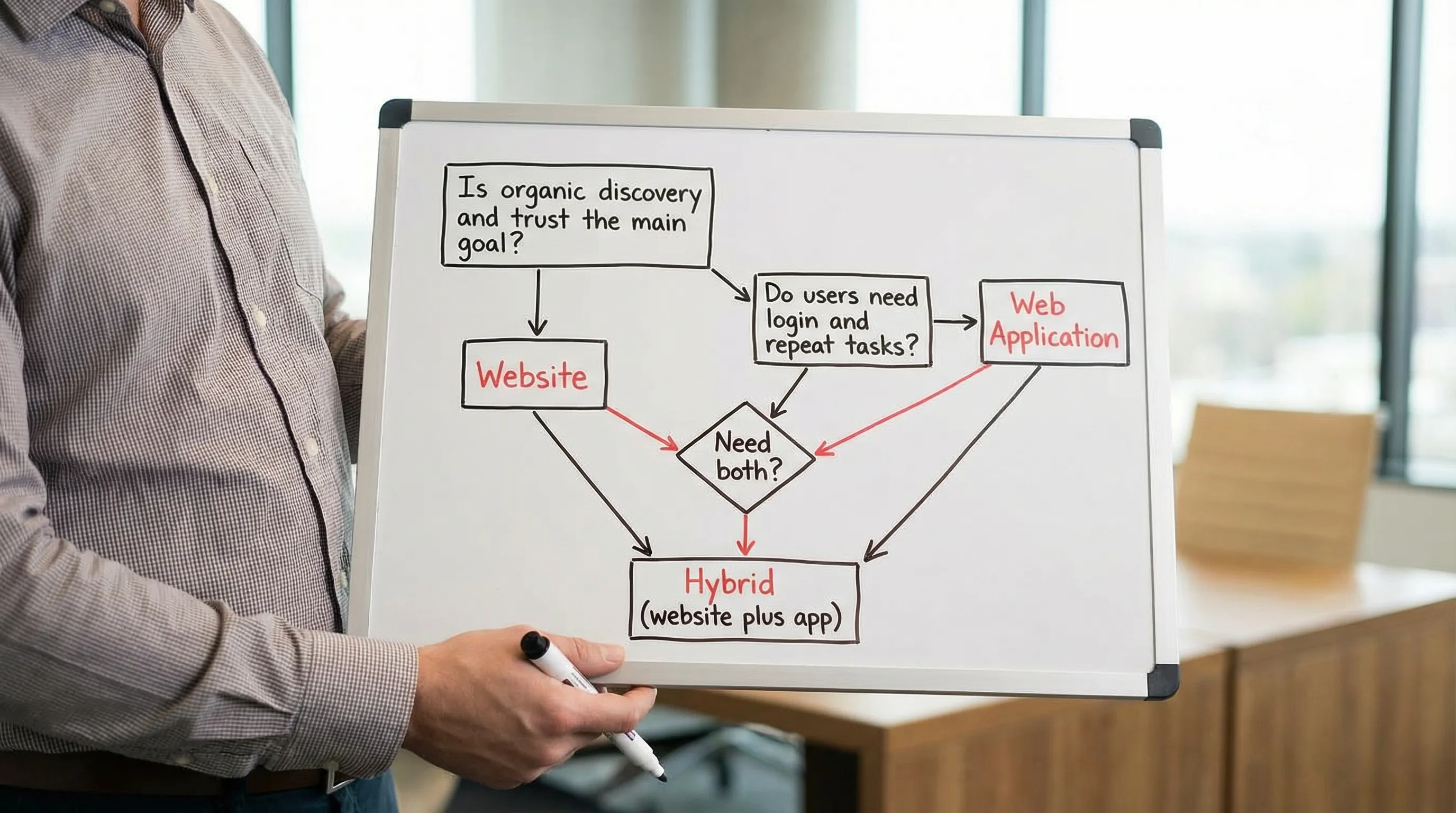
Common build paths that reduce risk
Path A: Website first, then web application
This works well when you need demand generation and clarity. You launch:
- A high-quality marketing site
- Analytics and conversion tracking
- Lead capture and sales flow
Then you add an app once you know what users actually want.
Path B: Web application MVP plus a minimal marketing site
This works when the product value is primarily functional and you already have a clear distribution channel (existing customer base, partnerships, outbound sales). The key is to avoid skipping positioning entirely.
Path C: Hybrid from day one (only when you have strong product clarity)
If you have validated demand and clear requirements, you can build both in parallel with shared design and brand system.
What to prepare before you talk to an agency or developer
You don't need a 50-page spec, but you do need clarity on a few things.
- Primary goal: leads, sales, adoption, operational efficiency
- Target users: who they are and what they are trying to accomplish
- Must-have features: the smallest set that delivers value
- Nice-to-haves: explicitly deferred
- Content inputs: brand, copy, images, legal pages, policy needs
- Success metrics: how you will measure launch impact
- Maintenance expectations: who updates content, who fixes issues, response times
This preparation is often the difference between a smooth build and a project that expands uncontrollably.
How Bildirchin Group can help
If you want a partner who can build either path, it helps to work with a team that does both websites and web applications, and can support what happens after launch (hosting, professional email, maintenance).
Bildirchin Group has been delivering digital solutions since 2010, including custom websites, web applications, hosting, professional business email, and ongoing maintenance. A good next step is typically a short discovery conversation to confirm:
- Whether your fastest win is a conversion-focused website, an application MVP, or a hybrid
- What should be in phase one vs phase two
- What risks (SEO, security, integrations, maintenance) need to be planned early
Choosing "website vs web application" is really choosing what to optimize first: discovery and trust, or functionality and self-service. Once that's clear, the build becomes far easier to scope, design, and launch successfully.