
Choosing a web development partner is one of those decisions that quietly affects everything else, your marketing performance, customer trust, hiring plans, and even how fast you can launch new products. The challenge is that many agencies can show attractive designs, but fewer can consistently deliver secure, maintainable, fast websites that support growth.
This guide walks you through a practical way to evaluate a web development services company so you can hire with confidence, avoid expensive rework, and set your project up for long term success.
Start with clarity: what you actually need built (and why)
Before comparing vendors, get clear on outcomes. A good web development company will help you refine requirements, but you will get better proposals if you can answer a few basics:
- What is the website's primary job? Lead generation, ecommerce, bookings, recruiting, documentation, or customer portal.
- What will success look like in 90 days after launch? More qualified leads, higher conversion rate, lower support tickets.
- What must integrate with the site? CRM, payment provider, ERP, email marketing, analytics, scheduling.
- Who will maintain it after launch? Your team, the agency, or a shared approach.
If you cannot explain the business goal, you will end up choosing based on visuals alone, and visuals are usually not what makes a project succeed.
Know the common types of web development services companies
Different providers are optimized for different problems. Knowing the category helps you evaluate fit.
Freelancers
Often strong for small projects and quick iterations. Risk increases if you need multiple skill sets (design, backend, SEO, security, DevOps) or long term coverage.
Boutique agencies
Smaller teams that typically offer hands on strategy and consistent communication. Great for custom websites, ecommerce, and web apps when you want a partner, not just "code delivery."
Large agencies
Strong process and capacity for complex programs, multi brand sites, or enterprise governance. Often higher cost and sometimes less flexible for smaller scopes.
Productized "site factories"
Fast and predictable packaging, typically built on templates. Good for speed and budget, less ideal for unique requirements or custom applications.
Evaluate technical fit: the stack, security posture, and performance mindset
A reliable web development company should be able to explain their technical decisions in plain English, and show how those decisions reduce risk.
Architecture and CMS choices (and whether you will be locked in)
Ask which platforms they recommend and why. For many businesses, a CMS (like WordPress or a headless CMS) is a practical choice, but custom applications may justify a framework based build.
What you want to hear:
- Clear tradeoffs (time to build, cost to maintain, hiring availability).
- A plan for content editing (non technical users).
- Data portability (how you can move your site later if needed).
Security practices you can verify
Security cannot be an afterthought, especially if you collect customer data, run ecommerce, or offer accounts.
Ask how they handle:
- Secure authentication and role based access
- Dependency updates and patching
- Backups and disaster recovery
- Web application firewall or similar protections
- Secure coding practices aligned with OWASP guidance
A credible company will talk about process, not just tools.
Performance and Core Web Vitals
Speed is not only a user experience issue, it can affect visibility and conversion rates. Ask how they build for performance and how they measure it.
Look for familiarity with Core Web Vitals and practical techniques like image optimization, caching strategy, and minimizing third party scripts.
Review their work the right way (beyond the portfolio)
Portfolios are necessary, but they can be misleading if you only judge visuals.
What to check on live sites
Open a few recent projects on your phone and desktop.
- Does the site feel fast and stable?
- Are forms simple and trustworthy?
- Is navigation clear without "creative confusion"?
- Are headings readable and consistent (good information architecture)?
If you want a benchmark for usability principles, Nielsen Norman Group's research is a strong reference point for UX best practices (see NN/g).
Ask for relevant case studies
A strong case study should include:
- The business problem
- Constraints (timeline, legacy systems, migration)
- What they built and why
- Measurable outcomes (conversion rate, lead quality, performance improvements)
If every case study sounds the same, treat it as a red flag.
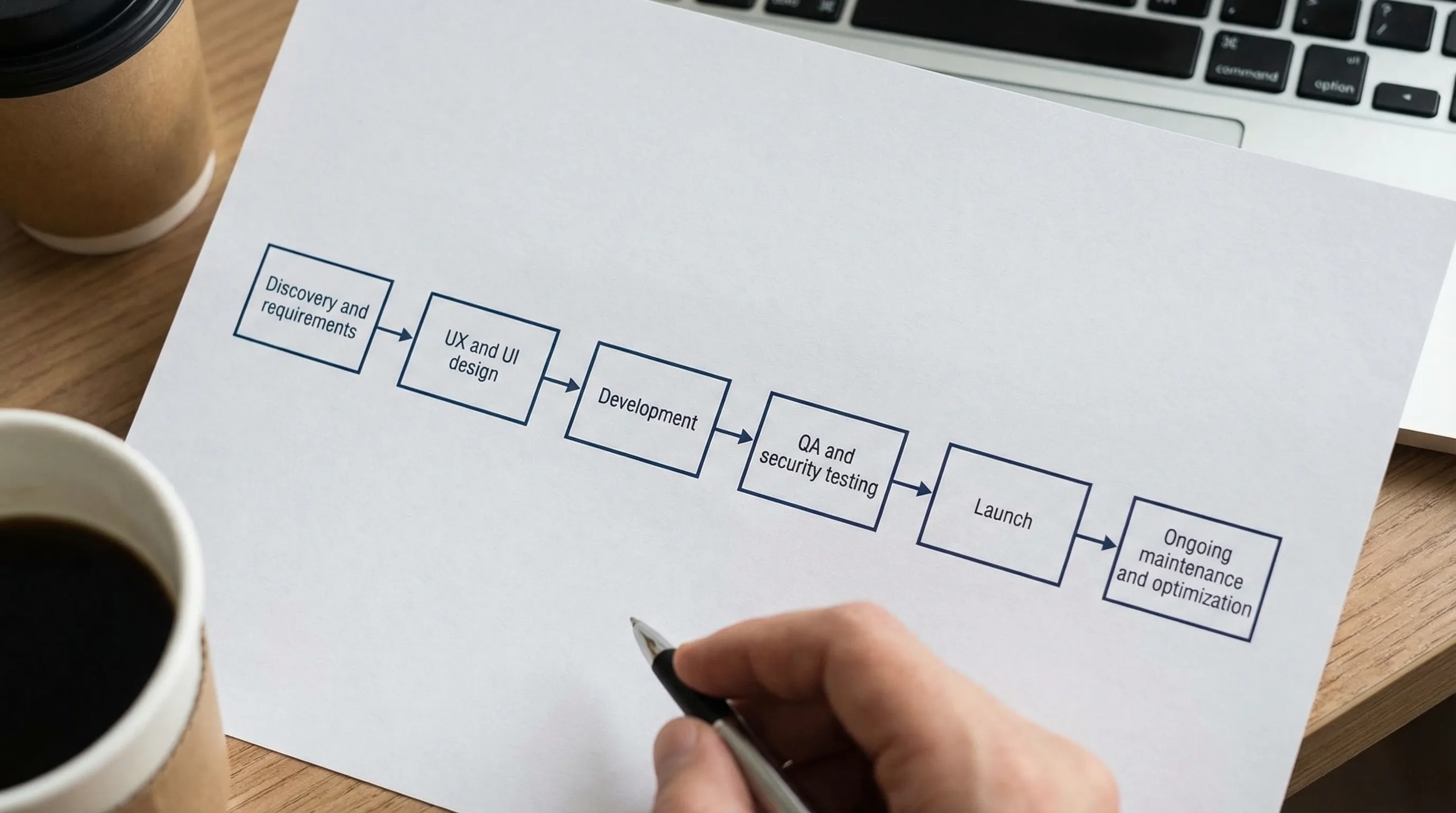
Assess their process: discovery, delivery, and what happens after launch
The best predictor of a smooth project is not a flashy demo, it is a repeatable process.
Discovery that reduces rework
Discovery should produce concrete outputs such as a sitemap, wireframes, technical plan, and a definition of "done." If a company tries to skip discovery to "save time," you often pay for it later.
Quality assurance that matches your risk
Ask what testing is included:
- Cross browser and mobile testing
- Form and conversion tracking validation
- Accessibility checks (basic alignment with WCAG)
- Security checks appropriate to scope
Launch planning
A professional company will outline how they handle:
- DNS changes and cutover
- Rollback plan
- Analytics and tracking verification
- Monitoring after launch
Maintenance is not optional
Websites age quickly. Plugins, frameworks, and server environments change, and security updates are ongoing.
If you want fewer surprises, ask for a maintenance approach covering updates, backups, uptime monitoring, and a process for small improvements.
Use a scorecard to compare candidates (example)
Comparing proposals can feel subjective. A simple scorecard makes the decision clearer.
| Category | What "good" looks like | Your notes | Score (1-5) |
|---|---|---|---|
| Business understanding | Can restate goals and suggest smarter options | ||
| Relevant experience | Similar industry, similar complexity | ||
| Technical approach | Clear stack choice, scalable, maintainable | ||
| Security and compliance | Specific practices, not vague promises | ||
| UX and content | Strong IA, conversion focused design | ||
| SEO readiness | Clean architecture, performance, technical SEO basics | ||
| Project management | Clear milestones, change control, communication | ||
| Post launch support | Maintenance, SLA options, documentation | ||
| Transparency | Clear scope, assumptions, and risks |
Tip: If you are choosing between close contenders, prioritize clarity and reliability over "big ideas." Execution wins.
Understand pricing models (and what they incentivize)
Most web development services companies use one of these engagement models.
| Model | Best for | Watch outs |
|---|---|---|
| Fixed scope, fixed price | Well defined websites and migrations | Change requests can become expensive if scope is unclear |
| Time and materials | Evolving products, complex integrations | Requires strong project management and transparency |
| Retainer | Ongoing improvements, marketing sites that iterate | Ensure deliverables and response times are defined |
Ask for a scope that explicitly lists what is included and excluded. Ambiguity is where budget overruns are born.
Ask these questions in the sales call (they reveal maturity fast)
You do not need to be technical to evaluate the answers.
- "What are the top three risks in a project like ours, and how do you reduce them?"
- "Who writes and owns the technical documentation?"
- "How do you handle change requests without slowing everything down?"
- "What does handover look like if we stop working together?"
- "How do you ensure the site is fast on mobile?"
- "What is your approach to accessibility and inclusive design?"
- "What support do you offer after launch, and what is the expected response time?"
If answers are vague, or they talk only about design trends, keep looking.
Red flags that often lead to failed projects
Some warning signs are subtle, but consistent:
- They cannot explain decisions without jargon.
- They avoid discussing maintenance, updates, or security.
- They promise unrealistic timelines without discovery.
- They quote without asking about integrations, content migration, or analytics.
- They will not define what success means.
- You do not know who will actually do the work.
Don't forget the "adjacent" services that can make or break results
Many projects fail due to gaps between vendors. Depending on your team, it can be simpler to work with a partner who can cover more of the stack, as long as they do it well.
Consider whether you want one provider for:
- Hosting and environment management
- Professional business email
- SEO foundations and analytics setup
- Ongoing website maintenance
This is less about convenience and more about reducing handoff errors and finger pointing.
Frequently Asked Questions
What should I look for in a web development services company? Look for relevant experience, a clear process (discovery to launch to maintenance), transparent scope and pricing, strong security practices, and proof of performance and usability on live sites.
How many web development companies should I get quotes from? Typically three to five. Fewer can limit comparison, more can slow decisions and create analysis paralysis.
Is it better to choose a local web development company? Not necessarily. Local can help with workshops and relationship building, but many teams work effectively remote. Prioritize communication quality, process, and accountability.
Who should own hosting and domains, me or the agency? You should retain ownership of domains and critical accounts. A good agency can manage hosting day to day, but ownership and admin access should stay with your business.
What is a reasonable timeline for a business website? It depends on scope, content readiness, and integrations. A credible company will give a timeline after discovery, with clear assumptions and milestones.
Choose a partner that can build and stay accountable
If you want a web development partner that can handle custom websites, web applications, hosting, professional business email, and ongoing maintenance, explore Bildirchin Group. Share your goals and constraints, and you will quickly see whether the team is a fit for your timeline, technical needs, and growth plans.